Thursday, 9 August 2012

Meeting the Family

One of the most important parts of this trip is having the opportunity to meet some of the far-flung members of our family. We certainly won't meet all of them, but we are making a concerted effort to meet many of them, and we started this week! After our days in Oslo, we took the train down to the dramatic valleys and beautiful waters of southern Norway to stay a week with my distant cousin and his family. Technically, this cousin is actually my father's second cousin, but a few generations back we came from such large families--my Oldefar (great-grandfather) was one of nine brothers, and my Oldemor (great-grandmother) was one of ten siblings--that many those in Dad's generation are about my age, and have young children in my generation. That is the case here, where the daughter in the family--my third cousin--is about eleven. All three members of the family welcomed us warmly and provided a wonderful combination of comfort and adventure during our stay.  I was excited to find out that my cousin's wife shares many of the same interests in art, handicrafts and decor that I do! We spent several happy evenings chatting about them.

We were truly impressed by the scenery in the area! The local Norwegians assured us that we would be less impressed if we had been visiting in the fog and dark of winter, but we had made sure not to try that experience, so we just got to gaze in wonder! Here, for example, is the view our family wakes to in the mornings in the summer:


Maybe its just the geologist in me, but I was wonderstruck! If one takes a bit of a drive (which we did), one can also visit the beautiful Kvås waterfalls:


Apparently this was a low flow volume due to the lack of rain in southern Norway this summer (unlike the rest of the country). If more regular volumes had been passing through, photography would have been impossible without a watertight camera due to the amount of spray!

Our hosts took us on two travelling adventures during our stay: The first was to Setesdal's Mineral Park, and the second was to Dyreparken (a combined zoo and amusement park). Both were fantastic!

At the mineral park, they've done a great job of combining large-scale displays outdoors of different Norwegian rock samples and of sculptures made from said rocks, and small-scale mineral displays indoors which showcase beautiful mineral samples from Norway and around the world.


Remember that the Three Billy Goats Gruff were Norwegian? Here they were again, with the cowering troll (perhaps not looking too scary this time) under the bridge.


 This enormous cluster of calcite was just one of the beautiful mineral samples collected in five indoor galleries that were carved out of the hillside behind the main entrance and mineral shop.

On the way home, the mist was coming in over one of the lakes, so I had to stop for a picture:


At Dyreparken we got a preview of some of the animals we hope to see in Africa, as they had a large enclosure where giraffes, zebra and several antelopes could graze. There were also animals from other parts of the world where we won't be visiting this year--like Siberia to check out the tigers, for example. We especially enjoyed the Norwegian section, though, where we saw lynx, moose, arctic fox (called fjellrev, or mountain fox here), deer, otters, wolverines, and a brief glimpse of grey wolves running off into the distance. The moose was one of the most obliging of the group, however, as this fellow was just hanging out by the fence, waiting to have his picture taken.


The amusement portion of the park was a clever balance of fairytale characters for the little ones, adventuresome pirates for those slightly older, and a carnival complete with stomach-churning rides for those tall (and foolish) enough. Only one of us was brave enough to go on this ride, and it wasn't the one typing this post!


He's up there somewhere!


One of the very clever things they did at the park was to create entire villages in the shapes of buildings, etc. from children's programs, then turn some of those into rooms and small apartments where people can stay overnight. It has contributed impressively to the appeal of the park to people who must travel a long distance with small children to visit it. As such, there is a full pirate village as well as Kardemommeby, a village from a book (later a TV show) about daily life and its childhood lessons.


Most important was the only law in town, roughly translated to be that one must be pleasant to others, not hurt anyone, and otherwise do as one wished.

The tower in the picture is the home of Tobias, the weatherman, who looked out his telescope to determine the weather. As you can see, the bakery was very popular with the visitors to the village.

This time, the impressive views on the way home were not only of the natural variety, but of the architectural, as we took a drive through Kristiansand with its traditional whiteboard houses, stately church, and very non-traditional performing arts center:


Saturday, 4 August 2012

Catching Up - Part 3


We reached Oslo late in the evening of July 28th to start a lovely stay at Clarion's Hotel Bastion. Despite being in an area marked by transition, the hotel successfully created an anbience of timeless courtesy and comfort. We were duly impressed and enjoyed our time there. We only had a couple of days in Oslo, so we decided that our tourist activities would be limited to a trip to the Folk Museum,  some walks around key areas such as Karl Johans Gate and Akershus Festning (Fortress), and a little shopping. For those of you who aren't from this part of the world, Karl Johans Gate is Oslo's main street leading from the train station at one end, passing Stortinget (the National Parliament), to the Royal Palace at the other.  Part of the street is closed to traffic to increase its appeal to pedestrians. On much of that section, street performers are now aplenty in the tourist seasons. Sorry I don't have a picture to show you--the walk was unplanned and I didn't have my camera. Here are a few from the Folk Museum, though:


The church at the top is a Stave Church. This was an architectural style of wooden, Catholic church used only in Norway--mostly between 1350 and 1650--before the state church became Lutheran. The churches were actually named for the staves, or pillars, that supported them. There were three main shapes used, of which the one shown is the largest--Borgund style. Many were richly decorated on the inside as well as having elaborate carvings on the door lintels and pillars. Sadly, of the approximately 1000 of these beautiful buildings once dotting the Norwegian countryside, only a handful remain.

The middle picture is of a woman preparing lefse in the traditional way on a hot grill over coals she generated in the fire beside. Everyday lefse is generally made with potato and is not sweet, but the variety she was making were made solely with grain flour (probably wheat, by the taste) and sweet. These would only have been used for festival times. She served them hot with butter--they were delicious!

The horse-and-buggy in the last picture is being pulled by a Fjordhest (fjord horse), one of three horse varieties native to Norway. Although the Fjordhest is not very tall, it is considered to be a horse, rather than a pony on account of its strength. The neck muscles are impressive! The mane is almost always trimmed short to show off the dark strip in the centre. The other two horse varieties are the Norlandshest (Northern Mountain Horse), which is similar to the fjord horse, but smaller yet, and the Dølehest (Norwegian Workhorse), which is a larger (between 14.1 and 15.3 hands high) draft horse.

Finally, from our time in Oslo, is a picture of Akershus Festning from our evening walk on July 30th.


Catching Up - Part 2


Once we returned to Sweden after our trip to the farm in Norway, we had only a few days to explore the other amazing things our friends in Uppsala wanted to share with us. First, we took a trip to see an old mine and ironworks at Österbybruk:


Can you imagine mining this pit with hand techniques? The entire thing was mined without modern machines! Unfortunately, my camera battery died before we reached the ironworks, so this picture of the old forge comes from the site http://www.svetur.se/sv/vallonbruken/products/105349/Osterbybruk/


The techniques for generating iron bars from ore were a specialty of the Walloon people of Belgium, so they had been enticed with good wages, housing and schooling for their children to come to Sweden and work at Österbybruk under significantly better conditions than the local Swedes who were doing the mining nearby.

The next day, we had a trip to the Uppsala University Museum of Evolution where we saw the holotypes of several dinosaur speciaes, and some amazing samples of others


They figure this fellow may once have survived the bite of a Megalodon on account of the holes in the lower jawbone that are not found on other samples. Not all the fossils were enormous, though. We also saw this beautifully preserved little specimen:


After that, we had to split up so we could see as many things as possible. Two of us travelled to Stockholm to see the Sami and textile exhibits at the Nordiska Museum and the Leaf Exhibition at Liljevalch's Art Gallery.


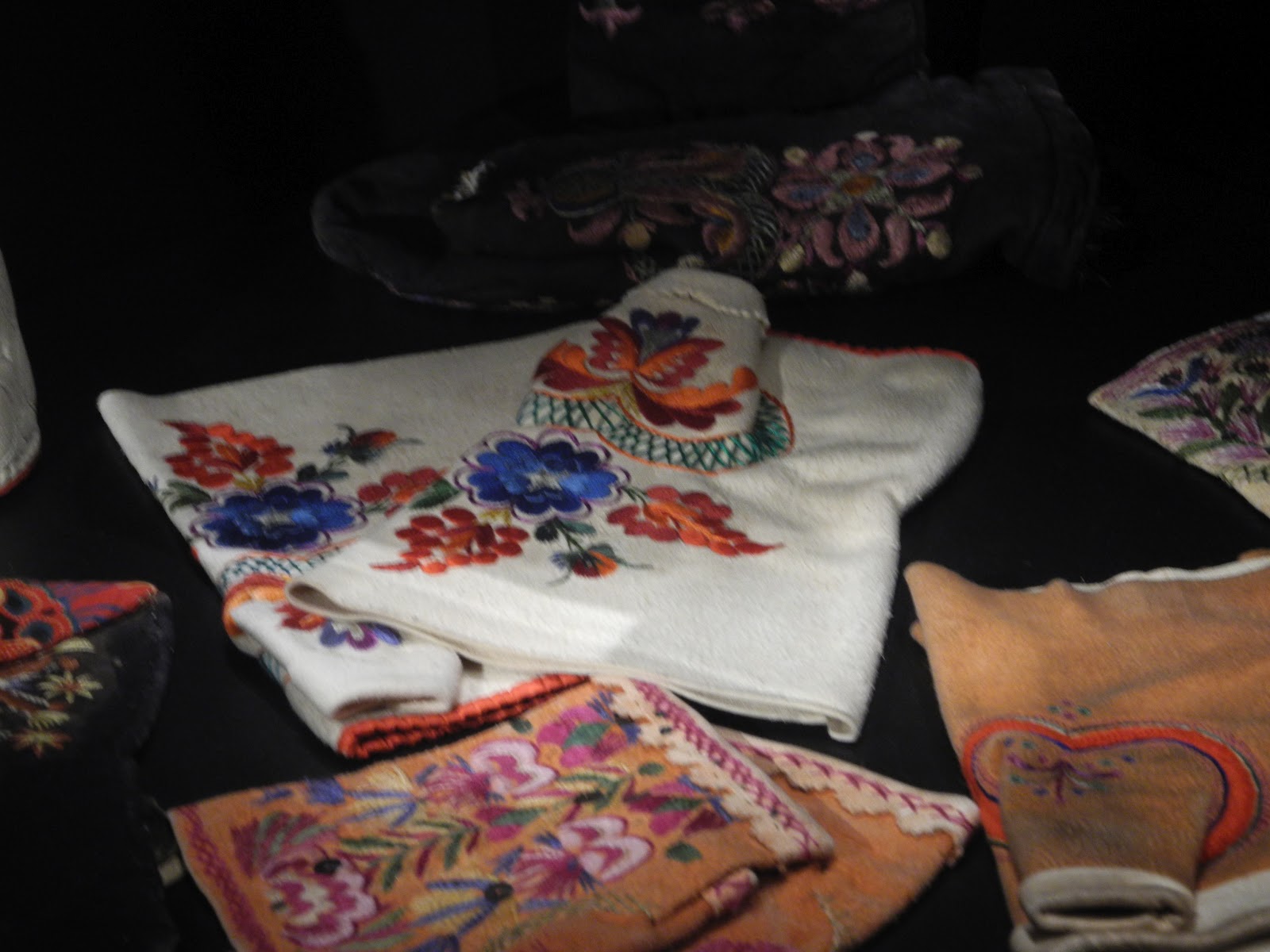
The embroidery above is a gorgeous sample of free-embroidery from the 1800s. The Leaf Exhibition is a result of 2000 artists interpreting the leaf shape they received from the museum, using an almost unbelievable range of handcrafts from carving to knitting, from embroidery to stained glass as well as anything else you might imagine. The project is in celebration of the100th anniversary of the
Handcraft Association (loose translation there, folks). The leaves were about the size and shape of a tennis racquet, and formed trees which filled three presentation halls! It was a truly impressive display!

The others stayed in Uppsala to visit the Gustavianum Museum where they saw the stunning Augsberg Art Cabinet, one of the worlds oldest operational anatomical theatres, many of the natural history collections of Carl Linneus and his followers, and some Ancient Egyptian sarcophagi.

Augsburgska konstskåpet
Here is a small picture of the art cabinet from the museum website, as picturetaking is not encouraged inside the exhibit. In actuality, the cabinet stands close to ten feet/two metres high, and is filled with the most amazing collection of personal and natural history items. Last year, I saw a website that showed many of the items up close, but I'm afraid I can't find it for you anymore. The other impressive aspect of the cabinet is the extraordinarily fine workmanship displayed in the inlayed patterns of the cabinet, itself.


On our last day in Sweden (July 28th), we stopped in Stockholm for a quick tour of the old city, Gamla Stan, and a visit to the Middle Ages Museum before travelling on to Oslo, Norway. Many of the buildings in Gamla Stan are from the 1600s and 1700s, with intricate cobblestone streets in between them. Since we were there at midday, we also got to see the Royal Guard coming up the bridge to the Royal Palace for the changing of the guard.


The time at the Middle Ages Museum was fascinating. Since Stockholm started as an island city at a critical stratigic location, much of its history was marked by war and plague. The museum effectively presented a realistic impression of life in those times with life-sized models of people and buildings as well as pictures an sound effects. Thankfully, they left out the smells of the time! (They did describe them in detail for those who were willing to read about it, however.)


Catching Up - Part 1


Well, we have been busy! We have been to Norway, back to Sweden, then back to Norway again! The first trip to Norway was to the farm in Hedmark (eastern Norway) where I was an exchange student many years ago. It was great to be back! My son also found it a welcoming experience, where he could relax while I got over my cold. He took a few pictures while we were there:


For us, the particularly impressive part of the last photo was that it was taken at 11:30PM. The midnight sun is still amazing for both of us!

As a special treat, our hostess took us for a trip north to Lillehammer where they held the 1994 Winter Olympics.


We also went to a fascinating amusement park called Hunderfossen, which was based entirely on the old Norwegian fairytales and folk stories recorded by Asbjørnsen and Moe about a hundred and fifty years ago, many of which are famous around the world (like the three billygoats gruff). Around the turn of the twentieth century, the artist, Theodor Kittelsen, created drawings and paintings of many of those same fairytales (for examples, check out this link to the Norwegian National Museum: http://mikro.nasjonalmuseet.no/kittelsen/docs/eventyr.shtm). Following Kittelsen's illustrations, another artist, Ivo Caprino, made a number of sculptures that were used in animated films of the fairytales originally collected by Asbjørnsen and Moe, perticularly in the 1960s. Scenes from the tales using Caprino's sculptures are on display at Hunderfossen, especially those involving the character, Askeladden (the Ash Lad). Unfortunately, no pictures were allowed, but here is a link to the park's webpage: http://www.hunderfossen.no/eventyrklubben/eventyrboka/  Stay on the Norwegian pages for good pictures, as few have been included on the English translation. Also at the park is a giant rendition of a sitting troll:


Of course, in Norwegian mythology, this would be a life-sized rendition, or a little on the small side for a mature troll! Some of the trolls in Kittelsen's paintings were the size of mountains.

On the way back to the farm, we saw a magnificent view of Lillehammer and the southern opening of the Gudbrandsdal valley:


Sunday, 22 July 2012

More of Interest


The old-style farm museum is actually a collection of several old buildings that Zorn purchased as folk in the Mora area decided to upgrade. The eldest house was from 1237; the newest was from the 18th century. Our guide told us that there were some important manners to help people who lived in such close quarters. If you look at the next picture, you'll see a suspended beam. There were two of these, one decorated and one not (at about the position where I was standing to take the picture).


Apparently, when you entered someone's house, you could only go as far as the un-decorated beam until a family-member invited you further. Also, the rule of the house generally stood that peace must be maintained on the family side of the decorated beam. Please note that the table and both bed chambers (one with a curtain shows on the right side of the photo) are on the peaceful side of the beam--I don't know how successful they were at keeping children from fighting at the table, but this seems like a great start!

On our way out of Dalarna, we made another stop to check out the world's largest Dala horse:


In case you aren't suitably impressed, know that that fellow in the foreground is about six feet tall. When he moved closer to it, he barely reached the knee of the horse. We also stopped at a very refreshing lake to let the kids have a swim before lunch and met up with this lovely Swedish family:

Having greatly enjoyed our time in Dalarna, we returned to Uppsala where we relaxed, did laundry and such mundane matters before having one more day of cultural activity before heading out to a week on a farm in Eastern Norway. Our cultural treat this time was a visit to the royal burial mounds in Gamla Uppsala (Old Uppsala) and the museum there. Unlike Jelling, most of the burial finds at Gamla Uppsala are from cremated remains, so most grave gifts, although originally impressive, have been severely damaged by fire. An exception was a find of a viking-age (or slightly before?) find from near, but not within the mounds, of some impressively preserved silver artifacts including bowls and chains of daily-use items that would hang from broaches as part of the standard (we think) clothing of a person of good social standing:


All the finds displayed an amazing complexity of workmanship with delicate carvings on many pieces.

On Tuesday, July 17th, we took the train across Sweden into Norway to visit friends who became as family many years ago, when I was an exchange student living at their farm. Thankfully, they were very understanding as I proceeded to sleep through the first several days of our visit.

Saturday, 21 July 2012

Back in Action

When I started this blog, the plan was to post a little more often than once a week--really! Unfortunately, I slept through most of this week after picking up a cold virus.  I'm told that this is part of the travelling experience. As such, I should probably relish said experience and share it with you in great, gory detail. Instead, I may just celebrate that it has almost completely succumbed to the efforts of my immune system. It really was fabulous having energy again today!

So, as I'm sure you can imagine, quite a lot has happened, especially since I didn't even manage to get caught up last time I wrote! We arrived in Sweden on the evening of July 9th. On the eleventh, our dear friends with whom we have been staying took us for an astounding three-day tour of one of Sweden's important cultural districts: Dalarna! We saw so many really cool things! Our first stop was Falun copper mine which operated for about 1300 years (estimates seem to vary regarding early operations from as early as 700 onward, but it was known to operate in 1080, and it only stopped active use as a mine in 1992) at different stages as an open pit and underground mine. It also boasted a 40m high hoist wheel and a 208m high foot bridge over a shaft to the underground workings:


See, it's a very long way down! The open pit and the field hospital were also very impressive. There were huge innovations in mining developed at Falun including mechanised hoist systems.  There were equally impressive medical innovations, but if I'm not telling you about my little cold, I'm certainly not sharing the gory details on those babies! (Seriously gory there folks--just think mining accidents before the invention of anaesthesia and you know I need to go no further)


While still in Falun (town) we went to the Dalarna Museum to check out impressive cultural contributions such as the world-famous, wooden "Dala" horses, Swedish traditional folk costumes and embroidery beyond compare!


On the second day we split up into two groups: one went to check out waterfalls and a limestone quarry loaded with columns and columns of cephalopod fossils; the other went to Anders Zorn's old-style farm and textile museum.


Saturday, 14 July 2012

Wow! Have we ever been busy!


It is very difficult to realise that we are already at the middle of July! The stay on the boat in Copenhagen harbour was great! Here's a picture of it:


I've been told that while Norwegians use the word "frokost" to refer to breakfast, the Danish use the same word to refer to a mid-day meal. Fortunately, in my last post I was referring to a meal we ate late in the morning, so I wasn't entirely wrong in either sense. (Perhaps not entirely right either, but we can let that slide.) One of the local sights I really wanted to share with you is this phenomenon I observed of beautiful stands of hollyhocks growing out of the cobblestones at the base of buildings all around Christianshavn (the area of Copenhagen where we were staying).


On our last day in Denmark, we did some heavy-duty sight-seeing! We started the morning with a canal tour of the city before moving on to a picnic lunch in the botanical gardens, a pleasant wander through the geological museum, and a mad dash through Rosenborg Castle in the hour before it closed. Apparently time dilates a little when some of us come into the vicinity of beautiful mineral samples.


We hadn't realised ahead of time that Rosenborg also houses the Danish Royal Treasury, so it was a great treat when we got there and found out we could go through as part of the ticket!

On July 9th, we took the train over a large bridge and across much of southeastern Sweden to Stockholm and further to Uppsala where we have been staying with friends ever since. It was wonderful to see familiar faces and to be greeted with hugs and welcoming even though our train had experienced "tekniske vanligheter" (technical difficulties of unknown origin) which resulted in our arrival being delayed by about half an hour. Apparently there are as many construction delays on the various transportation networks here as we are accustomed to in Canada, so our hosts had been monitoring for such possibilities.

On our first full day in Sweden, we did some catch-up shopping for supplies, and checked out the grounds of Uppsala Castle.


The grounds in the picture aren't actually part of the castle surrounds, but the Botanical Gardens of the University of Uppsala. We had a bit of a wander through those after climbing up the slope to the castle. Our friends' daughter told us about an annual local road race in which she took part few years ago. She said that the most challenging part of the route was up the stretch of road up to the castle where we were walking. Since I was a little winded toward the top, I was truly impressed by the athletes who run the route! (And note that the botanical gardens are about halfway up the hill, so those of you who are snickering because it doesn't look all that high from here can just stop!)